

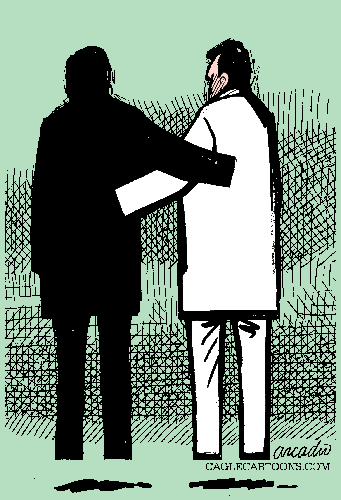
Okay, I’m going to take a big risk here, but this topic is such a source of raging controversy that, as a philosopher, I can’t ignore it.
Nothing raises the tension in a room faster these days than the mention of race. Everyone has an opinion, but if one is polite and doesn’t want to dive headfirst into a can of worms, one keeps it to oneself, whatever it is.
However, if you are among friends, you might dare approach the subject. Depending on what sorts of folks you and your friends are, you might begin with “I’m not a racist, but . . .”
Or perhaps, “I’m not afraid to say what everyone else is thinking but doesn’t dare say because of all this political correctness.”
In my circles, it’s usually something like, “It’s outrageous the way they are being treated” and eventually someone declares themselves to be “colorblind.”
I call (in polite company anyway) “codswallop.”
Whatever else we might be, we are not and cannot be “colorblind.” That is, totally oblivious of the fact that the person we are dealing with possesses a skin color different from our own. We cannot help noticing it any less than pink hair, elaborate makeup, a full beard or a loud shirt. Human beings are programmed to take notice of our fellows and register distinguishing characteristics.
In New Hampshire, having dark skin makes one stand out in a crowd. It is unavoidable.
All right, I get that what they mean when they say they are colorblind is that they do not allow color to affect how they judge a person. Again, codswallop.
Admit it, bleeding heart liberal, you go out of your way to be nice to people of color, more so than you would the average, run-of-the-mill white person. Not that this is a bad thing; non-whites have had a pretty rough deal in the past and deserve a little special treatment. But this isn’t being colorblind.
I don’t think that we should even aspire to be colorblind. Eventually, yes, wouldn’t it be lovely if differences in gender, race, religion and sexual preference were to become as irrelevant as eye color or the shape of your toes. But we aren’t there yet. Not even close.
There are realities of history and present-day society that must be acknowledged and addressed. Let’s face it: Justice isn’t always just, and who you are, including your race, makes a difference.
A lot of well-intentioned (or not) white people try to be empathetic and claim they understand what non-whites are going through. Do they really? I wish I did.
When I encounter somebody who is different from me, who speaks with an accent, dresses exotically, has a much nicer tan than I can ever hope to have, I am curious. I don’t want to offend, so I wouldn’t just walk up and say, “Gee, what’s it like to be an immigrant?” or “Is it tough being the only black person in Deerfield?” But I would welcome an opportunity to do exactly that.
My first responsibility as a middle-class, educated white person is to shut up and listen.
Listen to the poor, the disabled, the oppressed, the disadvantaged. They should be treated the way they want to be treated, not the way I, in my well-intentioned arrogance, think they ought to be treated.
Listen to people of color and take what they say seriously. Listen to Native Americans, immigrants from wherever, the working poor. Practice a little humility; allow them to speak for themselves instead of trying to speak for them. Give them the voice to advocate for themselves.
And remember that they are all individuals.
One Syrian refugee’s story may be very like another’s, but it won’t be exactly the same. A poor, black, single mother may struggle with many of the same issues as another, but each case is going to be unique because no two human beings are exactly alike. Native Americans may have many common grievances in the way they are and have been treated by the U.S. government, but the blanket term “Native American” covers a huge number of individual tribes, all with different cultures, languages and circumstances.
None are so blind as those who will not see, or listen, or acknowledge that yes, we are different. It is our universal need to be recognized for who we truly are that makes us all the same.
(Justine “Mel” Graykin lives and writes in Deerfield, and practices freelance philosophy on her website at justinegraykin.com.)